
Design Thinking for Social Good & Innovation
Research first. Ideate second. Design for real people.
Little Changemakers brings Design Thinking into real-world education, community and social-impact challenges. Our practice-led approach starts with understanding people, experiences and needs before moving into problem framing, ideation, prototyping and action.
Practice-Led Design Thinking
Design Thinking is most useful when it is applied to real people,
real constraints and real decisions.
Cherry Thian is the founder of Little Changemakers and a practitioner
with more than 20 years of experience across education, programme design,
community engagement, user-centred innovation and social enterprise
development.
Her approach places strong emphasis on user research before ideation.
Participants learn not only how to generate ideas, but how to first
understand experiences, identify meaningful needs, frame the right
problem and translate insights into solutions that can work in practice.
Understand Before Solving
Start with people, experiences, observations and context rather than jumping immediately into solutions or brainstorming.
Real Community Experience
Learn from actual work across schools, eldercare, healthcare, inclusive learning, CSR, service-learning and community innovation.
From Insight to Implementation
Explore how ideas are framed, prototyped, tested, adapted, communicated and implemented within real-world constraints.
Think Better With AI
Our school programme applies Little Changemakers' proprietary human-centred design model to AI-supported inquiry.
Design Thinking in Practice
Design Thinking is not just something we teach. It is how we approach real education, community and social-impact challenges. These projects show how research, empathy, problem framing and intentional design move ideas from insight to action.
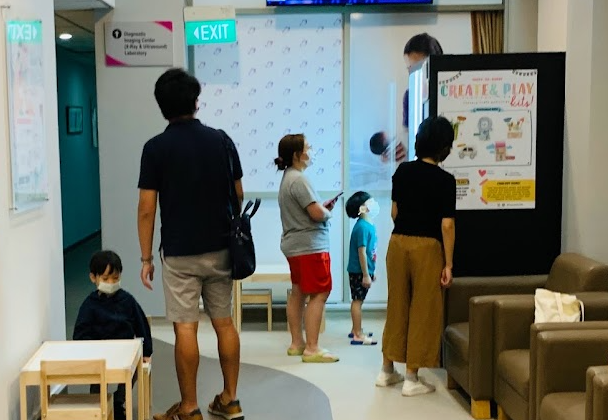
From Patient Insights to a 24/7 Play Solution
Patient and parent insights revealed long waits, limited access to play, infection-control concerns, space constraints and limited manpower. These needs led to a self-service vending solution with toys and activity kits for different ages and interests, including options for parent-child participation.
Read the case study →
Designing Anti-Shop Theft Campaigns
For an SPF and NCPC competition brief, students began with lived experiences of theft before developing core messages, visual metaphors and campaign concepts using our See, Think, Feel, Do approach.
Read the case study →
Designing Inclusive Sensory Activities
JC students worked with personas to understand sensory needs, participation barriers and individual strengths before redesigning everyday activities to make them more inclusive.
Read the case study →Customisable Talks and Workshops
All sessions can be customised to suit your audience, learning objectives, duration and preferred focus area. Sessions can be delivered as school talks, guest lectures, interactive workshops, design sprints, fireside chats or project consultations.
Assembly Talks and Workshops
Suitable for CCE, VIA, student leadership, values education, ECG, enrichment and school-wide exposure programmes.
Guest Lectures and Masterclasses
Suitable for university and polytechnic modules in social work, education, design, healthcare, psychology, entrepreneurship and community development.
Practitioner Sharing and Design Sprints
Suitable for teams exploring CSR, community impact, inclusive programme design, eldercare innovation or service-learning partnerships.
Possible Talk and Workshop Themes
Each theme can be adapted as a short talk, interactive workshop, guest lecture, design sprint or project consultation.
Design Thinking for Social Good
Participants learn how Design Thinking can be used to notice real needs, understand users, reframe problems and create practical community solutions.
Building a Social Enterprise from Community Needs
A practitioner sharing on how Little Changemakers grew from community needs into a purpose-driven business serving schools, seniors, corporates and community partners.
Designing Inclusive Sensory Activities for Children
A hands-on workshop where students learn how sensory needs can affect participation, then redesign everyday activities using persona cards and inclusive design prompts.
Rethinking Eldercare: From Activities to Purposeful Participation
A session on how eldercare programmes can support dignity, purpose, participation, wellness and meaningful contribution beyond conventional activities.
From Volunteering to Real Impact
Participants learn why good intentions are not enough, and how to design volunteer experiences that are respectful, useful, safe and meaningful.
Inclusive Programme Design for Communities
A practical introduction to designing programmes for children, seniors, caregivers, people with disabilities, volunteers and mixed-ability groups.
CSR and Community Partnerships
Participants explore how corporates and community partners can create meaningful engagement experiences that benefit both volunteers and beneficiaries.
Intergenerational Programmes and Community Innovation
A sharing on how children, youths, seniors, volunteers and community partners can learn from and contribute to one another.
From Learning to Real-World Design Projects
Some schools, organisations and care partners may want to go beyond a talk or workshop. Little Changemakers also provides user-centred design services for organisations that want to redesign spaces, programmes, care experiences and community engagement models.
Purposeful Community Spaces
We help partners design sensory rooms, eldercare activity spaces, intergenerational corners, engagement zones and community spaces that support participation and wellbeing.
Care Model and Engagement Design
We support care teams in rethinking how activities, routines, roles and environments can better support dignity, purpose, social connection and meaningful participation.
From Idea to Implementation
We design practical programme systems, facilitation resources, activity kits, volunteer flows and engagement models that can be tested, adapted and sustained on the ground.
Featured Workshop
Designing Inclusive Sensory Activities for Children
This 90-minute workshop helps students understand how sensory needs can
affect participation, then use Design Thinking to redesign everyday
sensory activities for children with different support needs.
The workshop helps students move from awareness to action. Instead of
only learning about inclusion, they practise designing for it.
Understand
Read the persona and notice strengths, interests, needs and possible barriers.
Choose
Pick one base activity or community challenge to build from.
Define
Name the main barrier or design problem to solve.
Adapt
Add inclusive supports while keeping the activity meaningful.
Pitch
Share the idea clearly with its learning value and inclusion outcome.
Engagement Formats and Indicative Fees
Final fees depend on group size, duration, customisation level, materials and facilitation needs.
Assembly Talk
45 to 60 minutes. Suitable for schools, CCE, VIA launch programmes and leadership groups.
Guest Lecture
60 to 90 minutes. Suitable for universities, polytechnics, seminars and professional modules.
Interactive Workshop
90 minutes. Suitable for schools, JCs, polys, universities and youth groups. For up to 60 participants.
Customised Workshop
90 minutes to 2 hours. Suitable for cohorts with specific learning outcomes or themes.
Half-Day Design Sprint
2.5 to 3 hours. Suitable for project-based learning, social innovation and service-learning.
Project Mentorship or Consultation
Suitable for student teams, service-learning projects and community innovation groups.
Invite Cherry for a Talk or Workshop
Looking for a meaningful talk, workshop or practitioner-led session
for your students or team?
We can customise the session based on your audience,
learning objectives and preferred focus area.